Araria Marches on Martyrdom Day and Takes on the Supreme
Court
Jan Jagaran Shakti Sangathan | 23 March 2026
“The harsh truth is that if you treat them worse than your cattle, they shall desert you, join the
Bhagat Singh, ‘Achoot Ka Sawal’ (The Question of the Untouchable), Kirti, June 1928¹
fold of other religions where they hope to enjoy more rights, where they are treated as fellow
beings.”
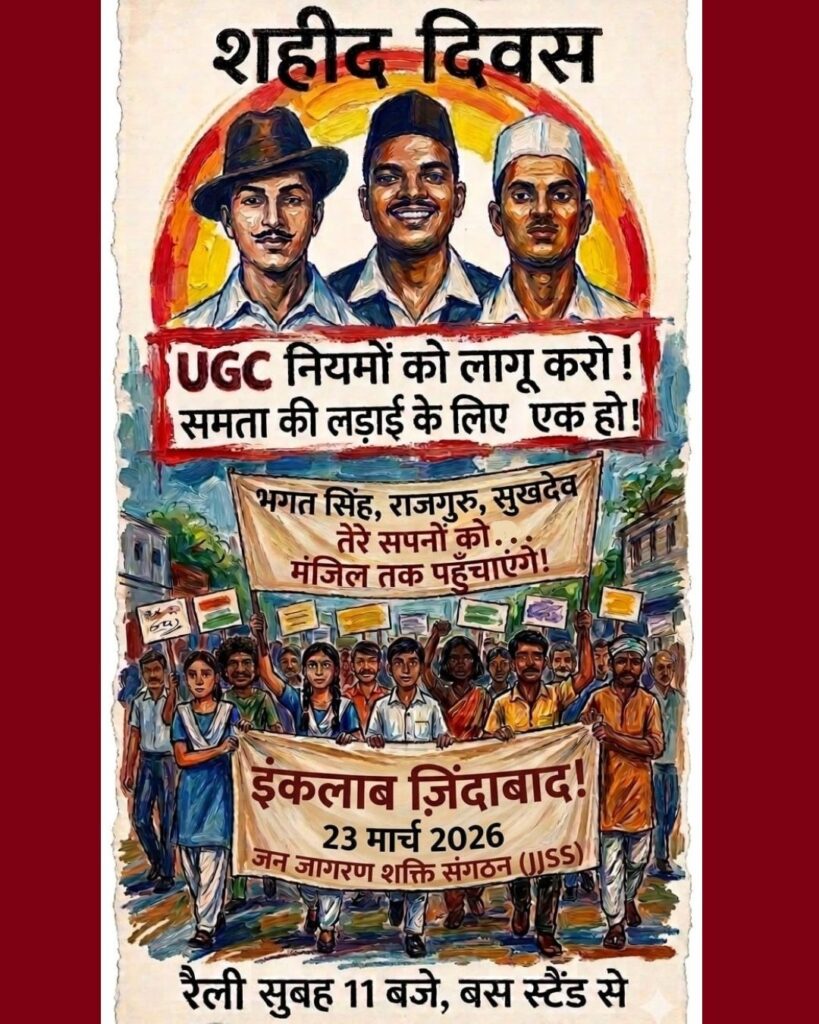
Ninety-five years ago, on the morning of 23 March 1931, the British government hanged three
young men in Lahore Central Jail ahead of schedule hours before the appointed time, in the dark,
so the streets would not have a chance to fill. They knew what would happen if Bhagat Singh,
Rajguru, and Sukhdev died in daylight. The crowd would be impossible to contain.
So they chose the dark.
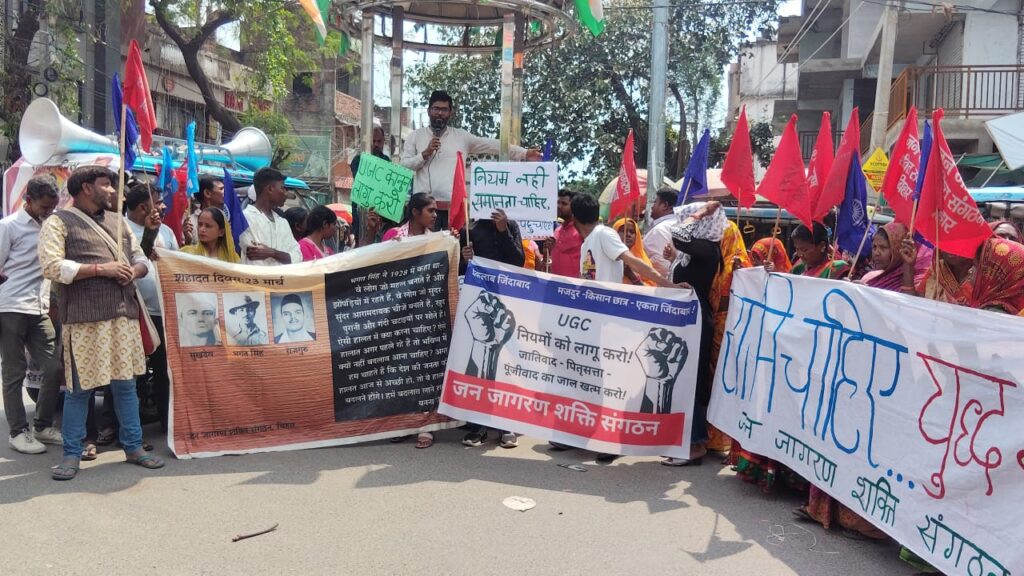
On 23 March 2026, in the town of Araria in northern Bihar, dozens of young people and workers
chose the light. They gathered at the bus stand, that familiar crossroads of arrivals and
departures, of people leaving for work in distant cities and returning with little more than tired
hands, and they marched. Through the ordinary streets of an ordinary town, past tea stalls and
shuttered shops, all the way to Chandni Chowk. There, they raised their fists, and their voices
rose with them.
“इंकलाब जिंदाबाद!” – Long live the Revolution!
And then, louder still, the chant that carried a promise across ninety-five years:
“Bhagat Singh, tere sapnon ko manzil tak pahunchayenge!”
Bhagat Singh, we will carry your dreams to their destination.
Who Was Bhagat Singh, Really?
In school textbooks, Bhagat Singh is often reduced to a young man in a felt hat who threw a
bomb. But those who have read his writings know a more uncomfortable truth: he was a thinker
who wrote with fury and precision against caste, against communalism, against colonial
extraction, against every arrangement that kept ordinary people crushed beneath the feet of the
powerful.
In the June 1928 issue of Kirti, published from Amritsar, Bhagat Singh wrote an essay titled
‘Achoot Ka Sawaal’ – On Untouchability. In it, he confronted the India of his time with a
directness that remains uncomfortable nearly a century later. He attacked the hypocrisy of a
society that called six crore of its own citizens untouchable while claiming spiritual greatness.
And then he turned to address those who had been excluded directly, not with sympathy, but with
a call to action. He told the so-called untouchables, the real working class, he called them, the
pillars of the nation, to stop waiting for reform from above:
“You are the real working class. Workers unite, you have nothing to lose but your chains.
~ Bhagat Singh, ‘Achoot Ka Sawal’, Kirti, June 1928¹
Arise and rebel against the existing order. Gradualism and reformism shall be of no avail
to you. Awake, O sleeping lions! Rebel, raise the banner of revolt.”
He did not dream of an India that merely replaced British rulers with Indian ones while leaving
the same hierarchies of caste and class intact. The revolution he imagined was one in which
every person, regardless of birth, would walk as an equal. Liberation was not a gift to be
received; it was a condition to be seized.
Sunil, a young participant at the Araria rally, captured this precisely. Bhagat Singh, he said, was
against all forms of discrimination and had called on the people of this country to raise their
voices against communalism and casteism. He urged those assembled at Chandni Chowk not
merely to observe Martyrdom Day as a ritual, but to read Bhagat Singh, understand him, and
take up the struggle he had charted.
It is this Bhagat Singh, not only the martyr but the thinker, that Jan Jagaran Shakti Sangathan
chose to remember on Shahdat Diwas 2026. And it is this Bhagat Singh who makes the central
demand of the rally not incidental, but inevitable.
A Court, A Stay, and a Sentence That Said It All
On 29 January 2026, the Supreme Court of India stayed the UGC Samata Niyam 2026, the
University Grants Commission’s new equality regulations for higher education institutions. The
stay has caused anger across student and labour movements in the country.
The numbers explain why. Between 2018 and 2023, 98 out of every 100 students who died by
suicide at India’s premier institutions, the IITs, the NITs, the IIMs, were Dalit, Adivasi, or OBC.³
Complaints of caste discrimination in universities have risen by 118% over the past 4 years.³ In colleges
across the country, Dalit, Adivasi, transgender, and women students still face humiliation and
violence as a routine feature of academic life.
The UGC Samata Niyam 2026 was not a gift from above. It was the hard-won result of decades
of struggle by Dalit-Adivasi organisations and the families of those the system had already
destroyed – the mothers of Rohith Vemula and Payal Tadvi among them. What made these 2026
The regulations were significant and different from the weaker 2012 rules they replaced, which were their teeth. For the first time, institutions found guilty of caste discrimination could have their recognition
cancelled, and their funding stopped. For the first time, OBC students were explicitly included in
the protections. Every college would be required to establish an equal opportunity centre.
Committees would have mandatory representation for SC/ST/OBC and women. A 24/7 helpline
and online complaint mechanism would be mandatory.³
These are not radical demands. They are the minimum conditions under which a student from a
Musahar household in Araria, or a Dalit girl from Raniganj block, might walk into a university
classroom and be treated as a full human being. The court’s stay removed even that minimum. And Araria, on 23 March, said, “No.”
The March and the Meeting
The rally began at the bus stand and moved through the streets of Araria to Chandni Chowk,
where a public sabha was held. The banners carried all the connections at once: Bhagat Singh,
Sukhdev, and Rajguru on one side; on the other, raised fists and the words “Jativad- Pitrusatta-
Poonjivad ka jaal khatam karo!” – “End the web of casteism, patriarchy, and capitalism!”
Placards in the crowd invoked Birsa Munda, Savitribai Phule, and B.R. Ambedkar alongside the
three martyrs, a deliberate lineage that serves as a reminder that the struggle for equality in India
has never had a single face or name.
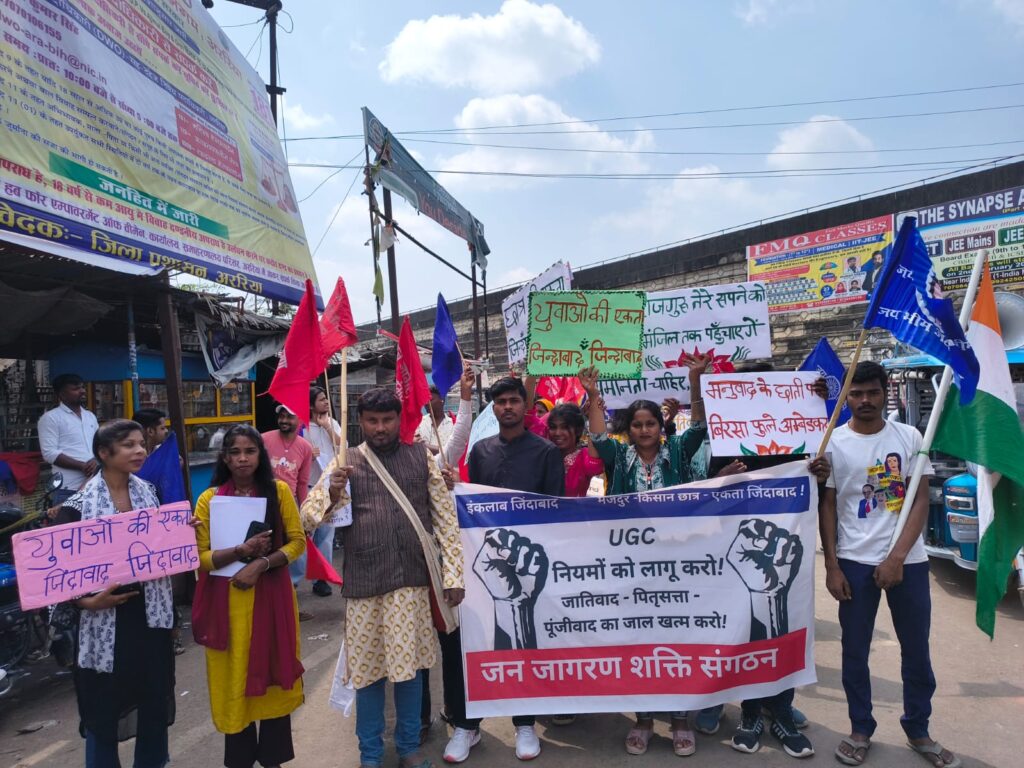
Ashish Ranjan, Secretary of JJSS, named the hypocrisy directly: a government that drafts
equality guidelines and then refuses to defend them in court has no real commitment to equality.
“Vishwavidyalayon mein bhedbhav ho raha hai jiske khilaf niyam banne chahiye. Ise laagu
karne ki sarkar ki mansha nahin hai isliye unhone court mein iske paksha mein koi dalil pesh
nahin ki.” “Discrimination is happening in universities, and rules must be made against it. The
government has no intention of implementing this, which is why they did not argue in its favour
in court.”
Ranjit Paswan, Mahanand Rishidev, Advocate Nawaz Alam, Munazir, Wadood Alam of the All
India Students’ Federation (AISF), Abhishek Kumar, Mandavi Devi, and Sunil Kumar also
addressed the gathering. The three demands placed before the public and the government were
clear:
- Strongly oppose the Supreme Court’s stay, passed under pressure from casteist forces, on
the UGC Samata Niyam 2026. - Enact a “Rohith Act” to end caste discrimination in colleges and universities across the
country. - Guarantee free, equal, and quality public education for every student, regardless of caste,
class, or gender.
The event was made possible by the ground-level work of Pawan Kumar Ram, Mayanand
Rishidev, Jyoti Kumari, Pooja Kumari, Lakshmi Kumari, Deepak, and others.
The Unfinished Journey
Faiz Ahmed Faiz wrote “Hum Dekhenge” in 1979, after General Zia-ul-Haq banned public
gatherings, music, and dissent in Pakistan. It became an anthem for everyone who has ever been
told that equality is not for now, not for here, not for you.
हम देखेंगे लाज़िम है कि हम भी देखेंगे वो दिन कि जिसका वादा है | जब ज़ल्मु -ओ-सितम के
~ Faiz Ahmed Faiz, “Hum Dekhenge,” 1979⁴
कोह-ए-गराँ रूई की तरह उड़ जाएंगे
We shall witness, it is certain that we too shall witness, that day which has been promised,
When the mountains of tyranny and oppression shall blow away like cotton.
The march from the bus stand to Chandni Chowk was, on the surface, a short walk through the
streets of Araria. But it was also something more. It was an answer to the Supreme Court’s stay
on the act. It was a set of numbers made visible in bodies and voices. It was young people from
one of Bihar’s most marginalised districts telling the country’s highest institutions: ‘ We see what
you are doing, and we will not pretend otherwise. ‘
Bhagat Singh was hanged before he turned 24. He did not live to see the India he
imagined, without the humiliation of caste, without the violence of communal hatred, without the
grind of exploitation. He wrote those final words from his prison cell, knowing he would be dead
within weeks, and still he wrote: the struggle continues.
The pamphlet distributed on the streets of Araria on 23 March closed with his words:
“Inqualab ki talwar vicharon ki shaan par tez hoti hai.”
“The sword of revolution is sharpened on the whetstone of ideas.”²
Those who marched that day carried both the ideas and the resolve. The destination has not been
reached. But the march continues.
“Bhagat Singh, tere sapnon ko manzil tak pahunchayenge.”
“Long live the revolution.”
And if that sounds old, it is only because the struggle is still unfinished
Talha Tanweer is the author of this blog and a Bachelor of Social Work (BSW) student at the Tata Institute of Social Sciences (TISS), currently undertaking a one-month fieldwork placement with JJSS.
Jan Jagaran Shakti Sangathan organised the rally. For more on JJSS’s work in Araria and
across Bihar, visit jjssbihar.wordpress.com, https://jjssbihar.in/.
Contact: 8092118525 / 9973363664
Citations and Sources
- Bhagat Singh, writing in Kirti, 1928. Reproduced in The Jail Notebook and Other
Writings, LeftWord Books, New Delhi. - Jan Jagaran Shakti Sangathan, Shahdat Diwas pamphlet, 23 March 2026. Distributed at
the Araria rally. - UGC Samata Niyam 2026 and Supreme Court stay: figures on institutional suicides and
discrimination complaints cited in the JJSS Shahdat Diwas pamphlet, 23 March 2026. - Faiz Ahmed Faiz, “Hum Dekhenge,” composed in 1979, published in Mere Dil Mere
Musafir, Maktaba-e-Karvan, Lahore, 1981.
Join the Conversation
Let us know your thoughts on this post.
No comments yet.